Research
Our group is passionate about advancing the frontiers of chemical biology, computational chemistry, and data-driven science. We combine experimental and theoretical approaches to tackle challenging problems at the interface of chemistry, biology, and data science.
Research Topics
Bioorthogonal Chemistry
We focus on the development and application of bioorthogonal reactions, which enable chemical transformations inside living systems without disrupting native biochemical processes. Our work spans reaction discovery, mechanistic understanding, and biomedical applications. This research is conducted in close collaboration with the Mikula Lab (TU Wien) and others, such as the Franzini Lab (University of Utah) on isonitrile click chemistry.
Representative publications:
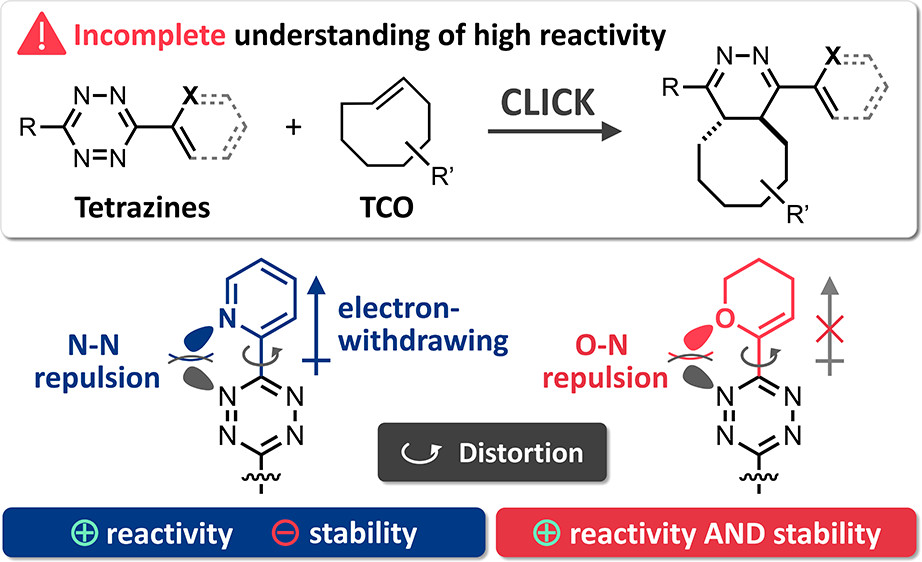
We revealed how pyridyl substitution in tetrazines enables fast, stable bioorthogonal tools by leveraging molecular distortion, overcoming the classic reactivity/stability trade-off.
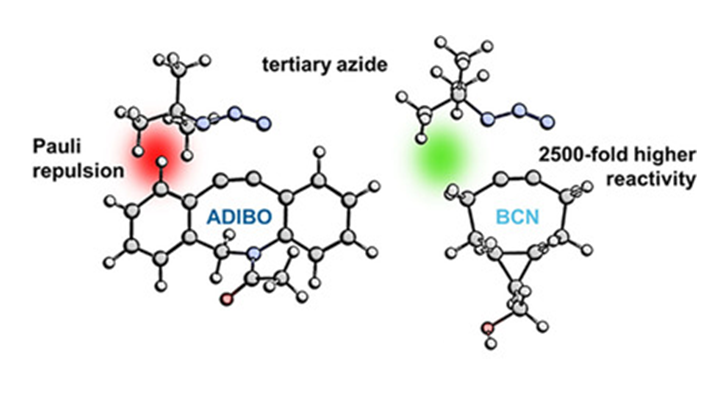
We revealed how steric Pauli repulsion in tertiary azides reshapes chemoselectivity with dibenzocyclooctynes, enabling highly selective dual labeling in copper-free click chemistry.
Reaction Mechanisms
We investigate fundamental organic reaction mechanisms using state-of-the-art computational chemistry tools. Our goal is to provide a detailed understanding of reaction pathways, thereby also enabling the rational design of new transformations.
Representative publications:
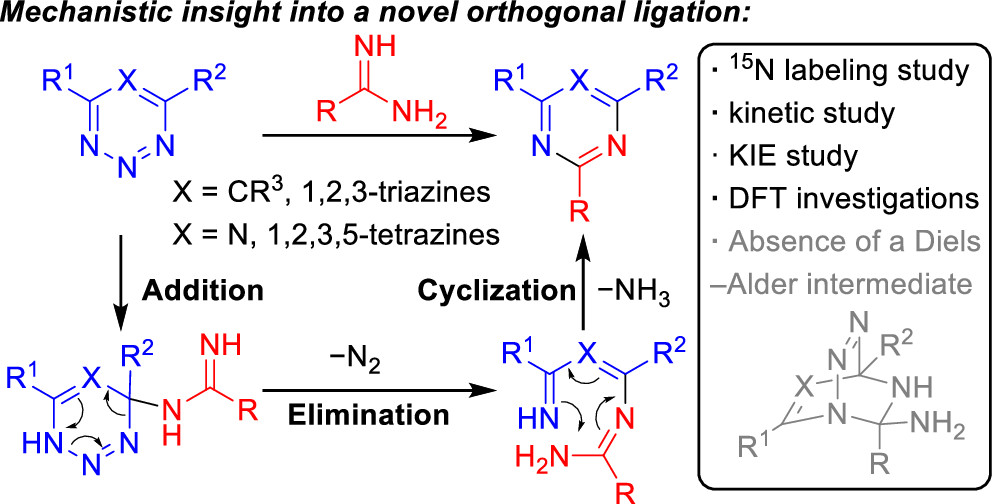
We uncovered that 1,2,3-triazines and 1,2,3,5-tetrazines react with amidines via nucleophilic addition/N₂ elimination/cyclization, overturning the expected Diels–Alder paradigm and explaining their unique orthogonal reactivity.
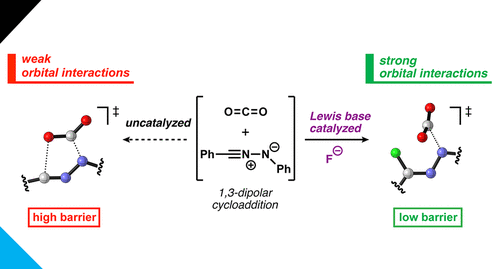
We reveal that F− catalysis in the CO2–nitrilimine 1,3-dipolar cycloaddition works by activating the nitrilimine, not CO2, raising its HOMO and shrinking the frontier-orbital gap to accelerate cycloaddition.
Energy Decomposition
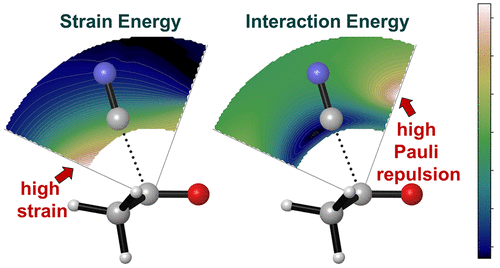
Our group heavily applies energy decomposition analysis (EDA) methods to gain a deeper understanding of the forces that govern chemical bonding and reactivity. By separating interactions into electrostatic, orbital, dispersion, and steric contributions, we provide mechanistic insight that goes beyond total energies. Additionally, we develop new EDA methods to enhance interpretability and applicability to complex systems.
Representative publication:
CompChem Tools
Our group develops tools that make computational chemistry easier and more accessible. This includes improved automated 3D structure generation from simple inputs as well as our web-based molecular viewer ChemView, designed for fast and intuitive visualization of quantum chemical results. These tools support researchers in exploring structures and reactivity without technical barriers.
Representative publication:
Explore the beta version of ChemView, our interactive molecular viewer designed for fast and intuitive visualization of quantum chemical results directly in the browser. Built to make computational chemistry data more accessible and user-friendly.
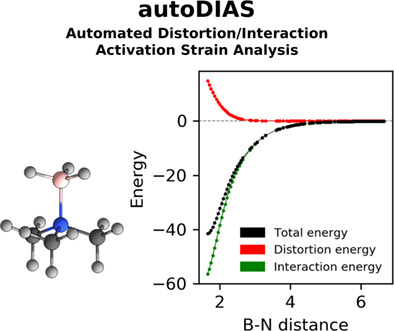
We developed autoDIAS, a Python tool that automates distortion/interaction activation strain (DIAS) analysis, handling setup, fragment detection, and data extraction with minimal user intervention.
Collaborators
We believe that collaborations are essential for great science. We are grateful for our current and past collaborators, and are always open to new partnerships. Please reach out if you are interested in working together!
Current
- Prof. Thomas Mindt (University of Vienna)
- Prof. Hannes Mikula (TU Wien)
- Assoc. Prof. Raphael Franzini (University of Utah)
- Prof. Ken Houk (UCLA)
- Assoc. Prof. Frederic Friscourt (University of Bordeaux)
- Assist. Prof. Xin Hong (Zhejiang University)
- Prof. Sharifuddin Bin Md Zain (University of Malaya)
Past
- Prof. Kathrin Lang (ETH Zürich)
- Prof. Dale Boger (Scripps Research Institute)
- Assist. Prof. Maren Podewitz (TU Wien)
- Prof. F. Matthias Bickelhaupt (VU Amsterdam)
- Prof. Israel Fernández (Universidad Complutense de Madrid)
- Dr. Johann Hlina (TU Graz)
- Assist. Prof. Trevor Hamlin (VU Amsterdam)
- Prof. Peter Gärtner (TU Wien)
- Assoc. Prof. Michael Schnürch (TU Wien)
- Prof. Matthias Herth (University of Copenhagen)
- Prof. M.G. Finn (Georgia Institute of Technology)
- Prof. P.G. Harran (UCLA)
- Prof. Matthias Barz (Leiden University)
- Prof. Vassil Delchev (University of Plovdiv)
Funded by